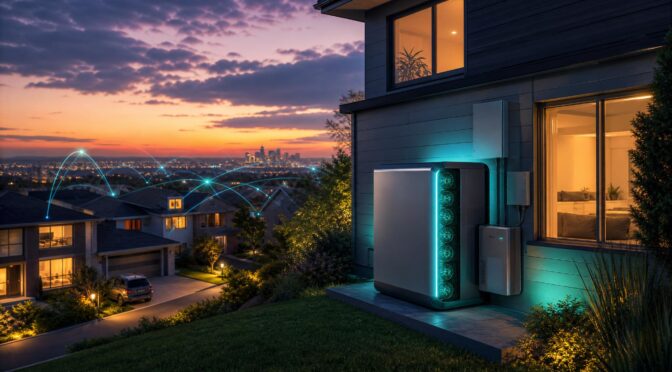
The AI boom has created a very physical problem: software may move fast, but power grids, substations, permits, fiber routes and data center campuses do not. SPAN, best known for its smart electrical panels, is now proposing a different approach with XFRA: a distributed data center model that places small AI compute nodes in residential and small commercial locations instead of relying only on huge centralized facilities.
The idea is both clever and slightly strange at first glance. Instead of waiting years for new mega-sites to get enough grid power, XFRA tries to use capacity that already exists at the edge of the grid. SPAN says its smart panel technology can identify and manage underused electrical headroom in homes and local buildings, then use that capacity to power AI inference, cloud gaming and other latency-sensitive workloads.
What SPAN and NVIDIA are building
SPAN describes XFRA as a distributed network of compute nodes located in homes and small commercial spaces. NVIDIA is listed as an initial launch partner, and the first solution is planned around enterprise-grade, liquid-cooled NVIDIA RTX PRO 6000 Blackwell Server Edition GPUs. Network World also reports that the hardware package is serious: a compact outdoor node with multiple high-end GPUs, CPUs and large memory capacity — essentially a small slice of data center infrastructure placed close to where people live.
This is not meant to replace hyperscale data centers. It is better understood as a complementary layer: centralized data centers remain essential for training giant models and running tightly coupled GPU clusters, while distributed nodes can serve inference workloads closer to users. Inference — the day-to-day use of already-trained models — is expected to become a very large share of AI compute demand, and it often benefits from lower latency.
Why this could matter for communities
Large data centers increasingly meet resistance from local communities. People worry about water use, noise, land use, grid pressure, diesel backup generators and whether the local area receives enough benefit in return. XFRA tries to change that equation by making compute more distributed and by using existing electrical infrastructure more efficiently.
If it works as advertised, the model could create several community-level benefits:
- Less pressure to build every AI workload as a mega-campus. Smaller edge nodes could absorb some inference demand without waiting for a traditional data center project.
- Lower latency for users. AI assistants, agents, local content generation, gaming and real-time tools may feel faster when compute is physically closer.
- Better use of existing grid capacity. Many homes and neighborhoods are not using their full electrical capacity all the time. Intelligent control could turn that unused capacity into useful infrastructure.
- New value for homeowners. SPAN’s proposal includes smart panels, battery backup and potentially discounted electricity or internet arrangements for hosts.
- More resilient local infrastructure. If paired with batteries and solar, distributed nodes could become part of a broader grid-edge energy system rather than just another box consuming power.
The impact on the AI experience
The most interesting part is not the box itself, but what it enables. A lot of current AI feels remote: prompts travel to large data centers, responses come back, and the user has little sense of where the compute happens. Edge inference could make AI feel more immediate and more integrated into daily life.
Lower latency can change the character of AI systems. Voice agents become less awkward. Interactive coding and design tools feel more fluid. Game NPCs and simulation systems can become more responsive. Local services could use AI without every interaction taking a long round trip to a distant region. For communities, schools, small businesses and public services, that could make advanced AI less like a far-away cloud product and more like local infrastructure.
The concerns are real
There are also good reasons to be cautious. Distributed infrastructure sounds elegant on a slide deck, but real neighborhoods are messy. A few concerns stand out.
- Security: A compute node mounted outside a home has a very different risk profile from equipment inside a controlled data center. Physical tampering, supply chain controls, remote management and tenant isolation must be excellent.
- Noise and heat: SPAN says the nodes are designed to minimize sound, but communities will still need transparent guarantees. Nobody wants a mini data center humming beside the bedroom window.
- Power fairness: If local grid capacity becomes valuable for AI compute, communities will want to know who benefits and who carries the risk during peak demand or outages.
- Maintenance complexity: Servicing thousands of small distributed nodes is harder than maintaining racks inside a few controlled facilities.
- Hardware lifecycle: AI hardware ages quickly. A node that is attractive today may need upgrades sooner than homeowners or municipalities expect.
- Community consent: The model will only work if people feel informed and respected. If it is pushed as “infrastructure by stealth”, it will meet the same resistance as many large data center projects.
There is also a technical limit. Some AI workloads need thousands of GPUs connected with extremely fast networking. Those jobs will stay in large, specialized data centers. XFRA is more likely to be useful for inference and edge workloads than for training frontier-scale models.
A promising idea, if trust comes first
SPAN’s concept is interesting because it treats AI infrastructure as both a compute problem and an energy problem. That is the right framing. The future of AI will not be decided only by model architecture or GPU supply; it will also depend on electricity, cooling, latency, regulation and whether communities accept the infrastructure required to run it.
If SPAN, NVIDIA and partners can make XFRA quiet, secure, transparent and economically fair, it could become a useful new layer between the home, the grid and the cloud. If they cannot, it risks becoming another example of AI infrastructure arriving faster than public trust.
That may be the real test. Not whether a mini data center can fit beside a house — but whether it can fit into a community.