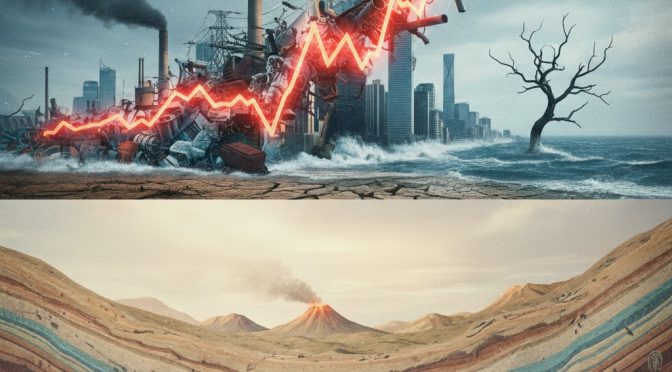
It’s a common refrain in coffee shops and online forums: “The climate has always changed. Why are we panicking now?”. History backs this up. Thousands of years ago, the Sahara was green. Millions of years ago, crocodiles swam in the Arctic. Earth is a dynamic system that has cycled through deep freezes and scorching hothouses long before humans ever struck a match.
But as we navigate 2026, climate experts aren’t worried about the fact of change—they are terrified by the unprecedented speed of it and a sobering reality: Mankind may have already missed the window to turn this disaster around.
Here is why the “natural cycle” argument fails in the face of our current crisis, and why the path to reversal is nearly blocked.
1. The Speed Trap: Evolution Can’t Keep Up
In the past, natural climate shifts occurred over millions or thousands of years. This allowed life to adapt. If a forest became a desert over five millennia, the trees “migrated” via seed dispersal, and animals evolved thicker fur or larger ears.
Today, we are compressing those same changes into decades. We are currently warming the planet 10 times faster than the recovery from the last Ice Age. We have built a global civilization based on a “stable” climate that lasted 10,000 years, and that stability is vanishing in a single human lifetime. Evolution doesn’t work that fast; our crops, our ecosystems, and our infrastructure are effectively “trapped” in a world that no longer exists.
2. The Persistence of Carbon (The “Bad Debt” Problem)
The most frustrating reason we can’t just “stop” climate change is the physics of CO2. Unlike smog or acid rain, which clear up weeks after you stop the pollution, Carbon Dioxide stays in the atmosphere for 300 to 1,000 years.
Even if the entire world went “Net Zero” tomorrow morning, the $CO_2$ we emitted in 1990, 2010, and 2024 would still be up there, trapping heat. We are living with the “climatic debt” of our grandfathers, and our grandchildren will be paying for our emissions well into the year 2300.
3. The Feedback Loop: When Nature Takes Over
Perhaps the biggest reason we have little chance of a full reversal is that we are losing control of the thermostat. We are approaching—or have already hit—Tipping Points:
- The Albedo Effect: As white Arctic ice melts, it reveals dark ocean water. Dark water absorbs more heat than white ice, which melts more ice.
- Permafrost Thaw: Vast stretches of Siberia and Canada are thawing, releasing ancient methane—a gas 30 times more potent than $CO_2$.
Once these natural “feedback loops” gain enough momentum, it won’t matter if humans stop using fossil fuels entirely. The Earth will continue to warm itself.
4. The Human Element: Psychological and Political Inertia
Even if the science were easy, the “human software” is poorly programmed for this crisis.
- Economic Addiction: Our global economy is a 500-year-old machine built on cheap energy. To “turn it around” requires a total dismantling of how we eat, move, and build—something no political system has shown the stomach to do at the necessary scale.
- The “Not Me” Bias: Recent studies in 2026 show that while 90% of people believe climate change is real, over 65% believe they personally are at lower risk than others. This psychological distance leads to “learned helplessness”—the feeling that the problem is too big to fix, so why try?
The Verdict: Is it Too Late?
If “turning it around” means going back to the cool, predictable world of 1950, the answer is likely yes. That world is gone.
However, “disaster” is a spectrum. There is a massive difference between a world that is $2^\circ\text{C}$ warmer and one that is $4^\circ\text{C}$ warmer. We may not be able to stop the storm, but we still have a say in how many lifeboats we build and how hard we hit the brakes. The tragedy of 2026 isn’t that we can do nothing—it’s that we are running out of time to do enough.
Can humanity adapt to a crisis it created, but can no longer control?
Yes—but not by going back. Adaptation now means building for a world we no longer recognize, rather than trying to save the one we’ve already lost.
We are doooooomed!