For decades, the standard prepper playbook revolved around the classic triad: beans, bullets, and bandages. Traditional preparedness meant stacking shelves with freeze-dried rations, stocking water filtration units, keeping spare fuel in the shed, and having a bug-out bag ready by the door.
Yet, modern crises—from prolonged regional blackouts and undersea fiber-cable severing to cyber warfare and satellite vulnerabilities—have exposed a blind spot in the modern homestead: information dependence.
We live in a world where almost all human technical knowledge—how to treat an infected wound, purify municipal gray water, hotwire an emergency generator, diagnose plant blight, or navigate back roads—lives in “the cloud.” The moment telecommunications drop or DNS servers blackout, that collective knowledge vanishes from reach.
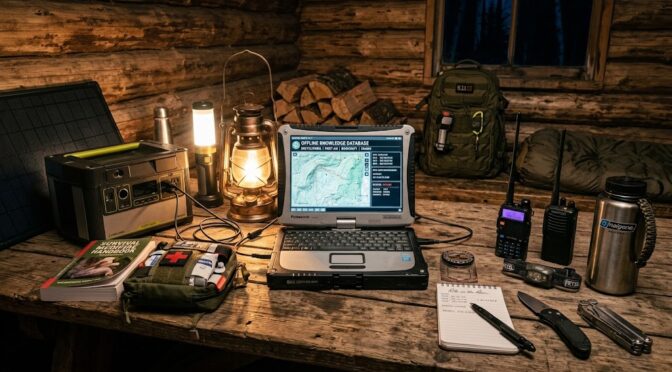
This vulnerability sparked the rapid rise of N.O.M.A.D. (Node for Offline Media, Archives, and Data)—an off-grid knowledge bunker and computing framework that turns local hardware into a resilient, independent survival hub.
What Exactly Is N.O.M.A.D.?
N.O.M.A.D. stands for Node for Offline Media, Archives, and Data.
Originally conceived as an open-source, modular ecosystem deployed via lightweight containerization (Docker), the N.O.M.A.D. concept redefines disaster computing. Rather than relying on clunky, read-only thumb drives or expensive commercial “doomboxes,” a N.O.M.A.D. node is an active, air-gapped server and knowledge station that can be run on modest, power-efficient hardware.
At its core, a complete N.O.M.A.D. system bundles:
- Encyclopedic Archives (Kiwix / ZIM): Complete offline snapshots of English and regional Wikipedia, WikiHow, project Gutenberg, and technical repair libraries.
- Offline Street-Level Mapping (OpenStreetMap): Terabytes of detailed topographic, road, and satellite-level navigational maps accessible without a cellular or GPS lock.
- Emergency Medicine & DIY Blueprints: In-depth medical guides, surgical procedures, pharmacological references, and schematics for water purification and mechanical fixes.
- Local Artificial Intelligence (Ollama / Local LLMs): Privacy-first, offline Large Language Models that act as an interactive survival librarian, synthesizing answers across complex manuals without needing an active internet connection.
- Local Network Broadcast (Wi-Fi Hotspot): The ability to serve books, manuals, and data over local Wi-Fi to smartphones, tablets, and e-readers across your household or emergency shelter.
The Key Advantages of N.O.M.A.D. for Modern Preppers
1. True Digital Sovereignty
When you build a N.O.M.A.D. node, you own your data. There are no logins, subscriptions, external API keys, or remote telemetry tracking your activity. If a severe geopolitical event or localized grid collapse severs the internet, your library remains fully operational on your local machine.
2. Interactive AI Without the Cloud
Searching through 10,000 PDF pages by hand by candlelight is neither fast nor practical during an emergency. By integrating local LLMs with retrieval databases (RAG), N.O.M.A.D. allows you to ask plain-language questions like:
- “What is the dosing ratio of calcium hypochlorite to disinfect 50 liters of water?”
- “How do I wire a 12V deep-cycle battery in parallel to maintain voltage?”
- “What are the differential diagnoses for a puncture wound showing red streaks?”
The system pulls directly from verified offline medical and engineering documentation to deliver quick, actionable summaries.
3. Lightweight Energy Footprint
A well-configured N.O.M.A.D. node does not need a massive server rack. Many preppers build mobile nodes on:
- Refurbished Mini-PCs (e.g., Intel N100 / AMD Ryzen mini-desktops): Consuming only 10–25 watts under normal load.
- Toughbook or Rugged Laptops: Offering built-in keyboards, screens, and battery backups that can be charged via a 100W portable solar blanket or 12V vehicle socket.
- Portable SSD Arrays: Storing 2TB to 4TB of high-density knowledge in a pocket-sized package.
4. Psychological Calm and Morale
Survival psychology demonstrates that uncertainty and isolation are two of the greatest hazards in long-term crises. Beyond practical handbooks, a N.O.M.A.D. archive can store classic literature, educational resources (such as offline Khan Academy), and family photos—maintaining structure, normalcy, and cognitive focus when the outside world is in turmoil.
General Use Cases: When Does N.O.M.A.D. Prove Its Worth?
| Scenario | How N.O.M.A.D. Functions |
| Prolonged Power Outage | Powers up via small battery stations (EcoFlow, Jackery); serves repair manuals, emergency first-aid protocols, and communications guides to your family’s mobile phones. |
| Grid Cyberattack / Telco Outage | Provides street and regional maps when cellular navigation fails, allowing you to plot evacuation routes around bottlenecks. |
| Bug-Out / Mobile Retreat | Runs in your vehicle or off-grid cabin to replace hundreds of kilograms of physical reference books with a single durable drive. |
| Community Assistance | Transforms your location into an information hub for neighbors, dispensing essential water-sanitizing formulas, radio frequencies, and survival guides. |
How to Get Started with Your Own Node
- Audit Your Hardware: Dig out a reliable spare laptop, a low-draw mini-PC, or an external high-speed NVMe SSD.
- Download Core ZIM Files: Using tools like Kiwix
, download complete offline bundles: Wikipedia (no images or with images), WikiHow, and the Survival & Medical Wiki collections. - Pull Vector Maps: Download regional or continental vector maps via offline OpenStreetMap viewers (such as Organic Maps or OsmAnd).
- Deploy Containerized Services: Explore open architectures like Project N.O.M.A.D. on GitHub
to automate local LLM setup, knowledge servers, and local web portals. - Drill Offline: Disconnect your router’s WAN cable, switch off mobile data, and spend a weekend managing tasks solely from your offline node. Note down what manuals or data points you were missing and update your drive.
Final Thoughts
Prepping is fundamentally about resilience, adaptability, and self-reliance. While canned food and water filters keep you alive day-to-day, knowledge is what rebuilds and sustains security.
Integrating the N.O.M.A.D. concept into your emergency setup ensures that no matter what happens to the global web, your access to human innovation and survival wisdom remains completely intact.
Stay prepared, keep your backups cold, and join the discussion in the comments below at Xtension.dk.