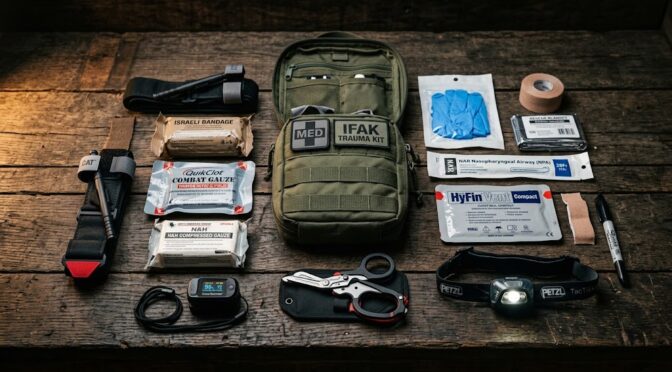
When modern infrastructure fails—whether through natural disaster, prolonged blackouts, or civil disruption—the 112 emergency response network vanishes with it. In an austere or off-grid scenario, you and your family become the primary healthcare providers, triage officers, and trauma surgeons.
Most off-the-shelf first-aid kits are designed for minor scraped knees and superficial cuts. If you are preparing for authentic crisis management or building an agile bug-out setup, you need a setup that bridges the gap between tactical trauma triage (TCCC standards) and sustained home clinical care, enhanced by smart, compact diagnostic technology.
Here is how to build a practical, rugged, and high-tech medical kit designed to protect your household and deploy instantly in a grab-and-go bug-out bag.
1. Modularity & Chassis: The “Tear-Away” Core
The best medical gear in the world is useless if you cannot find what you need in under five seconds under stress or in the dark.
Primary Enclosure: Cordura Rip-Away IFAK/EMT Bag
Choose a bag with laser-cut MOLLE webbing and hook-and-loop backing (e.g., 500D or 1000D Cordura). This allows you to keep the pouch mounted on a wall bracket, vehicle headrest, or plate carrier/rucksack, yet rip it free with a single pull.
Internal Organization: Color-Coded Modular Inserts
Organize using high-visibility tear-out pouches or elastic retention bands:
- Red: Immediate massive hemorrhage control (tourniquets, hemostatics).
- Blue: Airway and respiratory management (chest seals).
- Yellow/Green: Diagnostics, burns, minor wound management, and medication.
2. Tier 1: Massive Bleeding & Trauma (The MARCH Protocol)
In critical emergencies, uncontrolled arterial bleeding is the leading cause of preventable death. Your kit must prioritize rapid, intuitive trauma interventions:
- Combat Application Tourniquets (CAT Gen 7 or SOFTT-W):
- Keep at least two authentic, proven tourniquets accessible on the exterior of the pouch without unzipping.
- Rule: Never buy uncertified clones—plastic windlasses can snap under high tension.
- Hemostatic Gauze (QuikClot Combat Gauze / Celox Rapid):
- Coated with kaolin or chitosan to initiate rapid clot formation in junctional wounds where a tourniquet cannot seat (groin, axilla, neck).
- Emergency Pressure Dressings (Israeli Bandage / Olaes Modular):
- Multi-functional 4″ or 6″ pressure bandages with built-in pressure bars to compress deep soft-tissue trauma.
- Vented Chest Seals (HyFin Vent or Foxseal):
- For penetrating thoracic wounds (sucking chest wounds). Always carry a twin pack to address both entry and exit punctures.
3. High-Tech Diagnostics: Precision Clinical Insight
When a hospital is not an option, guessing vitals is dangerous. Modern micro-electronics allow you to carry an entire triage ward in a pocket-sized footprint:
| Tool | High-Tech Feature | Survival Utility |
| Fingerprint Pulse Oximeter | OLED multi-directional display, plethysmograph waveform | Monitors SpO₂ and heart rate during respiratory distress or hypovolemic shock. |
| Non-Contact Infrared Thermometer | Silent mode, instant read, surface/body switch | Rapidly screens for fever, infection, or environmental hypothermia without cross-contamination. |
| Compact Digital Sphygmomanometer | USB-rechargeable wrist/bicep cuff | Tracks blood pressure trends to assess internal blood loss or pain shock. |
| High-CRI Medical Penlight / Headlamp | 90+ CRI (Color Rendering Index), low-lumen moonlight mode | Allows accurate assessment of pupil dilation, cyanosis, and tissue perfusion in complete darkness. |
| Smart Handheld Otoscope / Endoscope | Micro-camera with local Wi-Fi / direct USB-C feed to smartphone | Inspects deep ear canals, nasal passages, and puncture wounds without bulky clinical equipment. |
Tech Tip: Ensure all digital items utilize either standardized AAA/AA lithium cells (10+ year shelf life, cold-resistant) or direct USB-C fast charging compatible with your solar power banks and crank generators.
4. Extended Care, Burns & Wound Closure
Once immediate life threats are controlled, secondary survival depends on preventing infection and managing recovery over days or weeks off-grid:
- Suture-Free Wound Closure (ZipStitch / CloSys / Steri-Strips):Traditional suturing requires sterile surgical skills and introduces infection risk. Micro-staplers or modern zip-type wound closures allow clean, pain-reduced edge approximation in field conditions.
- Burn Hydrogels (BurnTec / Water-Jel):Sterile hydrogel dressings that immediately draw heat away from thermal or chemical burns without sticking to raw tissue.
- Antiseptic & Irrigation:Pressurized sterile saline eye/wound wash bottles, Betadine (povidone-iodine) swabs, and medical-grade medical honey (Manuka) for prolonged antibacterial barrier defense.
- Heavy-Duty Trauma Shears (Leatherman Raptor or OneShear Extreme):Standard medical shears struggle on thick denim, heavy winter jackets, or boots. Invest in carbide or 440C stainless steel trauma cutters with an integrated ring cutter and oxygen wrench.
5. Medical Stockpile & Pharmaceutical Loadout
Store medications in waterproof, airtight cases with desiccant packs:
- Broad-Spectrum Antibiotics (Consult your physician): Amoxicillin-clavulanate, Ciprofloxacin, or Doxycycline for systemic or skin infections.
- Pain & Inflammation Management: Paracetamol (Acetaminophen), Ibuprofen, and localized numbing agents (Lidocaine gel).
- GI Defense: Loperamide (anti-diarrheal), Oral Rehydration Salts (ORS packets), and Activated Charcoal.
- Allergy & Respiratory: Epinephrine auto-injector (EpiPen) for anaphylaxis, plus non-drowsy Cetirizine/Diphenhydramine.
6. Dual-Mode Deployment: Home vs. Bug-Out Transition
To ensure your kit excels in both a suburban shelter and an austere forest bug-out, follow the tiered packing philosophy:
- Base Layer (At Home): The kit rests on a quick-release magnetic or hook-and-loop wall mount near the central pantry or safe room. The full diagnostic suite and extended pharmacological reserves are attached.
- Go-Bag Conversion (Under 30 Seconds):Unclip the secondary fluid bottles; pull the primary IFAK core and slip it into your pack’s top lid or external MOLLE panel. Weight remains strictly under 1.8 kg (4 lbs), leaving room for essential rations, water purification, and navigation gear.
Final Thoughts: The Mindset Behind the Gear
A premium titanium trauma shear or a military tourniquet is only as capable as the hands wielding it.
Equipping yourself with cutting-edge medical hardware is just the baseline. Take a certified Stop the Bleed or Wilderness First Responder (WFR) course, train your family on basic tourniquet staging, and review expiration dates twice every year (e.g., at daylight saving transitions).
Preparedness is not about fear—it is about self-reliance, competence, and taking care of the people who matter most when nobody else is coming.
For more gear tear-downs, tactical survival guides, and preparedness analysis, explore our latest articles at xtension.dk.